Cdes header
University of Minnesota
http://www.umn.edu/
612-625-5000
http://www.umn.edu/
612-625-5000
Thursday, July 25, 2013
Feminist Theory/ Boundary Critique Theory
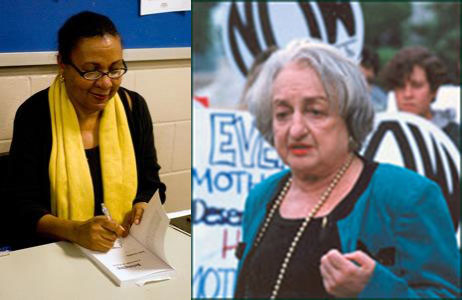
Bell Hooks Betty Friedan
(b. 1952- ) (b. 1921- d. 2006)
Media credit: Erin O’Leary
Source bell hooks photo: http://media.www.mtsusidelines.com/media/storage/paper202/news/2009/03/26/News/Bell-Hooks.Catches.Students.Attention-3683349.shtml
Source Betty Friedan photo:
1995 http://www.now.org/press/02-06/02-04.html
Summary:
The feminist perspective argues that gender differentiates subjective human experiences. Feminism is a relatively new term but not a new concept. The feminist movement has been categorized by three “waves” or “phases” that have been identified as change agents for women. Sexuality was the primary focus of the early British and American (1880-1930) first wave feminist movement. Suffragettes’ intent was to give women the right to vote and feminists’ intention was to bring an end to prostitution, rape, rape in marriage and venereal disease. Universally, women faced some form of oppression or exploitation. The early feminist goal was to end oppression against women.
The second feminist wave was between 1950 and 1970’s when women activists were identified as “women’s libbers”. Women questioned men’s “strangle hold” on positions of authority and leadership; women wanted acceptance and credibility, they wanted their lives to be taken seriously—to to be valued and studied. During this period, domestic violence precipitated the advent of shelters for battered women. It was the accepted belief that women’s place was first and foremost in the home. The relationship between structure and agency was a theme of the second wave as were women’s challenge to the ideas that family roles were divided along gender lines. Betty Friedan, author and feminist, wrote The Feminine Mystique in 1963 identifying “the problem that has no name” as the lack of women’s careers.
At the beginning of the third wave in the 1980’s, women were using the court system in response to the increase in battering, identified as “battered women’s syndrome” (BWS). The slowness of the process however, led to re-victimization of the same women. Baby Bust women born between 1960 and 1978 were less likely to self-identify as feminists because, although they did not identify feminists negatively, they believe others did and they did not see a need for a collective movement; that was an issue in the past but not a current issue. But a new type of feminist, who challenged the idea that gender was the primary factor determining women’s fate, was getting involved. bell hooks, author, scholar and a third wave feminist, argued that gender and race and class, together, determined women’s destiny. The name “bell hooks” is her pen name, which she wanted written in unconventional lower case to signify that her work is more important than her selfhood. She argued that The Feminine Mystique represented the opinion of white, middle to upper class, married, college educated women. Women of color and poor women’s voices had been excluded, but they have a unique and valuable role to play in the making of Feminist Theory.
It is accepted that Feminist Theory emerged from the feminist movement. A theme of male domination and female victimization has prevailed in the literature during the first two waves. Bell hooks and other third wave feminists challenged the ideas of the second wave feminists to explore different issues or new perspectives of old issues. She argues for the need of theory mapping, thought and strategy for a new mass movement. The theory would examine all cultures from feminist standpoint that is rooted in the understanding of gender, race and culture.
The sociologist view of feminist theory is not the individual woman but women’s diverse situations and the institutions that frame those situations in which women live their lives. A shared purpose of feminist theory is to challenge male dominance and power and to construct via understanding and action, a science where race, culture, gender and gender relation is wholly social and socially important. There is no one voice or unified self, consequently, there is no single feminist theory.
Level of Analysis:
Individual, family, household, societal and macro system.
Methods:
Qualitative, quantitative, mixed methods.
Application:
Excluding women from the design, selection and planning of the built environment has produced a living environment that does not meet women’s needs. This is evidenced in private homes as well as in public housing and creates many problems for women that include transportation, accessibility, and access to goods and services.
References:
Anderson, M. (2005). Thinking about women: A quarter century’s view. Gender & Society, 19(4), 437-455. Retrieved March 12, 2009 from http://www.jostor.org/stable/30044611.pdf
Brayton, J. (1997). What makes Feminist Research Feminist? The structure of feminist research within the social sciences. Retrieved January 25, 2009, from http://www.unb.ca/PAR-L/win/feminmethod.htm.
Chafetz, J. (2004). Bridging feminist theory and research methodology. Journal of Family Issues, 25(7), 963-977.
Friedan, B. (1963). The Feminine Mystique. New York, New York: Summit Books.
Gilligan, C. (1982). In a Different Voice. Cambridge, MA: Harvard University Press.
Hartsock, N. (1990). The Feminist Standpoint Revisited and other Essays. Denver: Westview Press.
Hayden, D. (1980). What would a non-sexist city be like? Speculations on housing, urban design, and human work. In C. Stimpson, et al (Eds.) Women and the American City (pp. 142-157). Chicago: University of Chicago Press.
hooks, b. (1984). Feminist Theory from Margin to Center. Boston: South End Press
Wednesday, July 24, 2013
Explanatory Theory of Environment Behavior Relations
Amos Rapoport
(b. 1929- )
Source: http://www.arch.usyd.edu.au/research/env_events.shtml
Summary:
Amos Rapoport was born in 1929 in Poland and graduated from the University of Melbourne at Australia in 1955. He is one of the founders of the Environment-Behavior Studies and studied cultural variables and cross-cultural theory. His seminal book, House, Form, and Culture is one of three books he has authored.
Explanatory theory of environmental behavior is focused on the study of environmental patterns and human relations. Rapoport defined built environment as (1) organization of space, time, meaning & communication; (2) setting systems; (3) cultural landscape, and the make up of fixed, semi-fixed & non-fixed features in order to figure out relationships between society and any built environment. More concrete and detailed settings can easily access environmental behavior and related issues. Dismantled cultural dimension should also clearly be defined in the housing environment. He considers environment as a system of settings.
Specific activities are interpreted within a particular system of setting. Housing as a system of settings is explained by dismantling of culture. “Cultural” is too broad to apply only to housing issues. Dismantling cultures, such as family structure, status, or ideal images, should give details to housing environment. His theory makes it easier to figure out housing environment in the dismantling of culture and concrete housing settings.
Rapoport categorized two parts of the dismantled cultural area. One is social domain and the other is ideological domain. Dismantled social parts described kinship, family structure, roles, social network, identity, status, and institutions, etc. Dismantled ideological expression is in values, ideals, images, norms, standards, expectations rules, life styles, and active system.
Level of Analysis:
Cultural group, individual.
Methods:
Content analysis, behavioral mapping.
Application:
Various housing environment and human activities occur in a complex cultural context. In order to analyze and figure out housing environment and its’ activities in different cultures, we put the environment in new settings and systems to define the housing environmental behavior. In addition, we dismantled cultures as another setting. Or we may place new setting to understand new social environment. For example, sustainable housing concepts are a new setting of systems.
References:
Rapoport, A. (2001). Theory, culture and housing. Housing Theory, and Society, 17: 145–165.
Rapoport, A. (1995). Environmental quality and environmental quality profiles. In A. Rapoport Thirty-Three Papers in Environment-Behavior Research. Newcastle: Urban International Press, pp. 471-488.
Rapoport, A. (1997). Theory in environment-behavior studies: Transcending times, settings and groups. In S. Wapner, et al. (Eds), Handbook of Japan-U.S. Environment-Behavior Research (Toward a Transactional Approach) New York: Plenum, pp. 399-421.
Rapoport, A. (1998). Using ‘culture’ in housing design. Housing and Society 25 (1 and 2), 1–20.
Environmental Press Theory
M. Powell Lawton
(b. 1923- d. 2001)
Source: http://www.proqolid.org/proqolid/instruments/philadelphia_geriatric_center_morale_scale_pgc_morale_scale?private=yes&fromSearch=
Summary:
Over the past century, emphases on person and environment aspect of human behavior have been developed by social scientists. Among them, the psychologist Kurt Lewin developed the “ecological equation” which is B= f (P, E). That is, behavior is a a function of the person and environment. Based on the ecological equation, Lawton and Nahemow (1973) found that a graphic schema is convenient to illustrate relationship between person and environment (see Fig. 1).
In the model, “competence” is ability within a person such as physical or mental health, intellectual capacity or ego strength. The range of competency is from low to high. Poor physical health, age-related sensory losses, mental health problem and so on result in lowered competency. “Environmental Press” is a limiting aspect of environment and leads to a behavior-activating response for some individuals. The strength of press is varied in positive, neutral or negative ways.
The shaded areas in Figure 1 are adaptation levels that are given by competence reacting to environmental press. This is obtained by everyday activities without awareness of the environment. However, it is possible that there are maladaptive behaviors or negative emotional states, if an individual is exposed to a high level of press. For example, if a woman is a wheelchair user, her competence is low so a kitchen designed for able-bodied people causes high pressure. To adapt her environment, she needs to modify her kitchen. If not, the environment leads her to maladaptation and the kitchen environment will change her behavioral patterns such as eating habits. To be more specific, she prefers to eat already cooked food such as donuts or hamburgers rather than food prepared by herself due to the environmental press of her kitchen.
If an individual is exposed to a low level of press, it causes a feeling of boredom, lassitude, deprivation, and a low demand to master the normal environment. Moreover, when someone is exposed to a low level of environmental press, their competence level will decrease. Thus, a limited level of press within any given adaptation level is required to maintain comparatively healthy status.
Application:
The elderly are more likely to have low competence for their environment so they need to increase their competence by adjusting the environment to adapt their level of competence according to Press-competence model. The characteristics of accommodating environment are the following. First, less severe environmental press is needed compared to the environment of original tenants. Second, mental and physical health starts to necessitate higher-intensity services; congregate meals, house-keeping services or on-site medical services might be needed. Last, spatial and structural demands increase for additional services such as wheelchair use or modification of bathroom.
As mentioned above, the Press-Competence Model can be applied to meet the needs of residents for their environment in both congregate housing and housing for independent living. To be more specific, congregate meals, house-keeping services or on-site medical services will be provide for residents with low competence level in congregate housing. In the aspects of housing for independent living, home modification will be offered to meet the needs of the elderly to age in place through reducing environmental press. According to Lawton (1082), the most common home modification examples to help the elderly age in place are the following: grab bars and shower seats (22.9%), wheelchair accessibility within the home (9%), railing (7.8%), and ramps at street level (5%). The majority of the elderly felt that home modifications mentioned above would help them to stay at home for a long time.
References:
Lawton, M. P. (1977). An ecological theory of aging applied to elderly housing. Environment and Aging, 31(1), 8-10.
Lawton, M. P. (1982). Competence, environmental press, and the adaptation of older people. In P.G. Windley & T.O. Byerts (Eds.), Aging and the Environment : Theoretical Approaches (pp.33- 59). New York: Springer.
Lawton, M.P. (1989). Three functions of the residential environment. Journal of Housing for the Elderly, 5 (1), 35-50.
Lawton, M.P. & Nehamow, L. (1973). An ecological theory of adaptive behavior and aging. In C. Eisdorfer & M.P. Lawton (Eds.), The Psychology of Adult Development and Aging (pp. 657-667). Washington DC: American Psychological Association.
Pynoos, J., Nishita, C. & Perelman, L. (2003). Advancements in the home modification field: A tribute to M. Powell Lawton. Journal of Housing for the Elderly, 17(1/2), 105-116.
Regnier, V. (2003). Powell Lawton’s contributions to purpose-built housing design for the elderly. Journal of Housing for the Elderly, 17(1/2), 39-53.
Subscribe to:
Posts
(
Atom
)


