

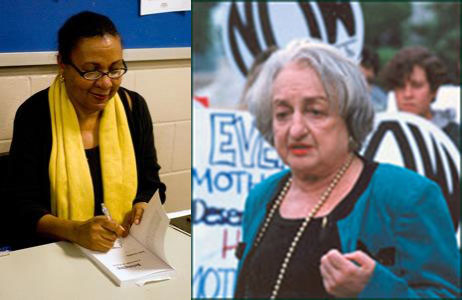
Bell Hooks Betty Friedan
(b. 1952- ) (b. 1921- d. 2006)
Media credit: Erin O’Leary
Source bell hooks photo: http://media.www.mtsusidelines.com/media/storage/paper202/news/2009/03/26/News/Bell-Hooks.Catches.Students.Attention-3683349.shtml
Source Betty Friedan photo:
1995 http://www.now.org/press/02-06/02-04.html
Summary:
The feminist perspective argues that gender differentiates subjective human experiences. Feminism is a relatively new term but not a new concept. The feminist movement has been categorized by three “waves” or “phases” that have been identified as change agents for women. Sexuality was the primary focus of the early British and American (1880-1930) first wave feminist movement. Suffragettes’ intent was to give women the right to vote and feminists’ intention was to bring an end to prostitution, rape, rape in marriage and venereal disease. Universally, women faced some form of oppression or exploitation. The early feminist goal was to end oppression against women.
The second feminist wave was between 1950 and 1970’s when women activists were identified as “women’s libbers”. Women questioned men’s “strangle hold” on positions of authority and leadership; women wanted acceptance and credibility, they wanted their lives to be taken seriously—to to be valued and studied. During this period, domestic violence precipitated the advent of shelters for battered women. It was the accepted belief that women’s place was first and foremost in the home. The relationship between structure and agency was a theme of the second wave as were women’s challenge to the ideas that family roles were divided along gender lines. Betty Friedan, author and feminist, wrote The Feminine Mystique in 1963 identifying “the problem that has no name” as the lack of women’s careers.
At the beginning of the third wave in the 1980’s, women were using the court system in response to the increase in battering, identified as “battered women’s syndrome” (BWS). The slowness of the process however, led to re-victimization of the same women. Baby Bust women born between 1960 and 1978 were less likely to self-identify as feminists because, although they did not identify feminists negatively, they believe others did and they did not see a need for a collective movement; that was an issue in the past but not a current issue. But a new type of feminist, who challenged the idea that gender was the primary factor determining women’s fate, was getting involved. bell hooks, author, scholar and a third wave feminist, argued that gender and race and class, together, determined women’s destiny. The name “bell hooks” is her pen name, which she wanted written in unconventional lower case to signify that her work is more important than her selfhood. She argued that The Feminine Mystique represented the opinion of white, middle to upper class, married, college educated women. Women of color and poor women’s voices had been excluded, but they have a unique and valuable role to play in the making of Feminist Theory.
It is accepted that Feminist Theory emerged from the feminist movement. A theme of male domination and female victimization has prevailed in the literature during the first two waves. Bell hooks and other third wave feminists challenged the ideas of the second wave feminists to explore different issues or new perspectives of old issues. She argues for the need of theory mapping, thought and strategy for a new mass movement. The theory would examine all cultures from feminist standpoint that is rooted in the understanding of gender, race and culture.
The sociologist view of feminist theory is not the individual woman but women’s diverse situations and the institutions that frame those situations in which women live their lives. A shared purpose of feminist theory is to challenge male dominance and power and to construct via understanding and action, a science where race, culture, gender and gender relation is wholly social and socially important. There is no one voice or unified self, consequently, there is no single feminist theory.
Level of Analysis:
Individual, family, household, societal and macro system.
Methods:
Qualitative, quantitative, mixed methods.
Application:
Excluding women from the design, selection and planning of the built environment has produced a living environment that does not meet women’s needs. This is evidenced in private homes as well as in public housing and creates many problems for women that include transportation, accessibility, and access to goods and services.
References:
Anderson, M. (2005). Thinking about women: A quarter century’s view. Gender & Society, 19(4), 437-455. Retrieved March 12, 2009 from http://www.jostor.org/stable/30044611.pdf
Brayton, J. (1997). What makes Feminist Research Feminist? The structure of feminist research within the social sciences. Retrieved January 25, 2009, from http://www.unb.ca/PAR-L/win/feminmethod.htm.
Chafetz, J. (2004). Bridging feminist theory and research methodology. Journal of Family Issues, 25(7), 963-977.
Friedan, B. (1963). The Feminine Mystique. New York, New York: Summit Books.
Gilligan, C. (1982). In a Different Voice. Cambridge, MA: Harvard University Press.
Hartsock, N. (1990). The Feminist Standpoint Revisited and other Essays. Denver: Westview Press.
Hayden, D. (1980). What would a non-sexist city be like? Speculations on housing, urban design, and human work. In C. Stimpson, et al (Eds.) Women and the American City (pp. 142-157). Chicago: University of Chicago Press.
hooks, b. (1984). Feminist Theory from Margin to Center. Boston: South End Press
