

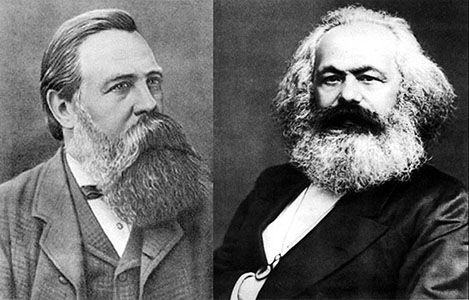
Frederich Engles Karl Marx
(b. 1820-d. 1895) (b.1818-d. 1883)
Source: http://en.wikipedia.org/wiki/File:Engels.jpg
http://en.wikipedia.org/wiki/File:Karl_Marx.jpg
Summary:
Marxism came into form between 1844 – 1848 through the writings of Karl Marx, a philosopher, and Friedrich Engels, a social scientist, both of Germany. Throughout history, their work has influenced many disciplines, some of which include: sociology, economics, history, political theory, philosophy, and anthropology. The motivation behind the development of Marxism lies in the dedication to the overthrow of the capitalist order. In which case, it is considered a macrolevel approach used to predict social change.
The theory of social change is rooted in the class struggle of the mid-nineteenth century relating directly to the conflict between the dominant (bourgeoisie) and subordinate (proletariat) social classes. Marx and Engels intended to provide a way of thinking that could help the proletariat regain control of their lives. They believed the purpose of economic activity was the satisfaction of human needs and the production of general well-being. However, from their perspective, capitalism counteracted this notion, creating an “us versus them” mentality between the middle and lower classes. And rather than establishing an environment that meets the needs of all its members equally, Marx and Engels saw capitalism as a means to increase the control and wealth of the bourgeoisie, while impoverishing the proletariat.
Marx and Engels suggest that under a capitalist regime, wage workers would become aware of their disadvantaged position in society. They go on to theorize that this realization of exploitation would lead to a revolutionary “class consciousness,” which would ultimately result in the transformation of the working class. In other words, it is hypothesized that with this newly discovered ”consciousness,” the proletariat would be motivated to rebel against the capitalist order in order to regain control of their lives. Through the organized actions of the working class, then, Marx and Engels argued that the result of class consciousness would ultimately end capitalism.
Level of Analysis:
Macro/Societal.
Methods:
Quantitative, qualitative, mixed methods.
Application:
Although highly based on economics and class wages, Marxist theory has also been used in the field of housing. Some topics related to Marxism include: rent gap, land use, and community organizing. In addition to these, a few studies have also used Marxist theory to explain the deterioration of housing.
References:
Barton, S. E. (1977). The urban housing problem: Marxist theory and community organizing. Review of Radical Political Economics, 9(4), 16-30.
Hughes, J. A., Sharrock, W. W., & Martin, P. J. (Eds.). (2003). Karl Marx. Understanding Classical Sociology, 19-85. New York: Sage Publications.
Marx, K., & Engels, F. (1969). Manifesto of the Communist party. Marx/Engels Selected Works, 1. Moscow, USSR: Progress Publishers.
McCall, P. (2008). “We had to stick together”: Individual preferences, collective struggle, and the formation of social consciousness. Science and Society, 72(2), 147-181.
Rapaport, A. (1968). A view of the intellectual legacy of Karl Marx. Social Science Information, 7(4), 7-15.
Skaburskis, A., & Moos, M. (2008). The redistribution of residential property values in Montreal, Toronto, and Vancouver: Examining neoclassical and Marxist views on changing investment patterns. Environment and Planning A, 40, 905-927.


